
Gray Wolves in Washington: The Return of the Pack
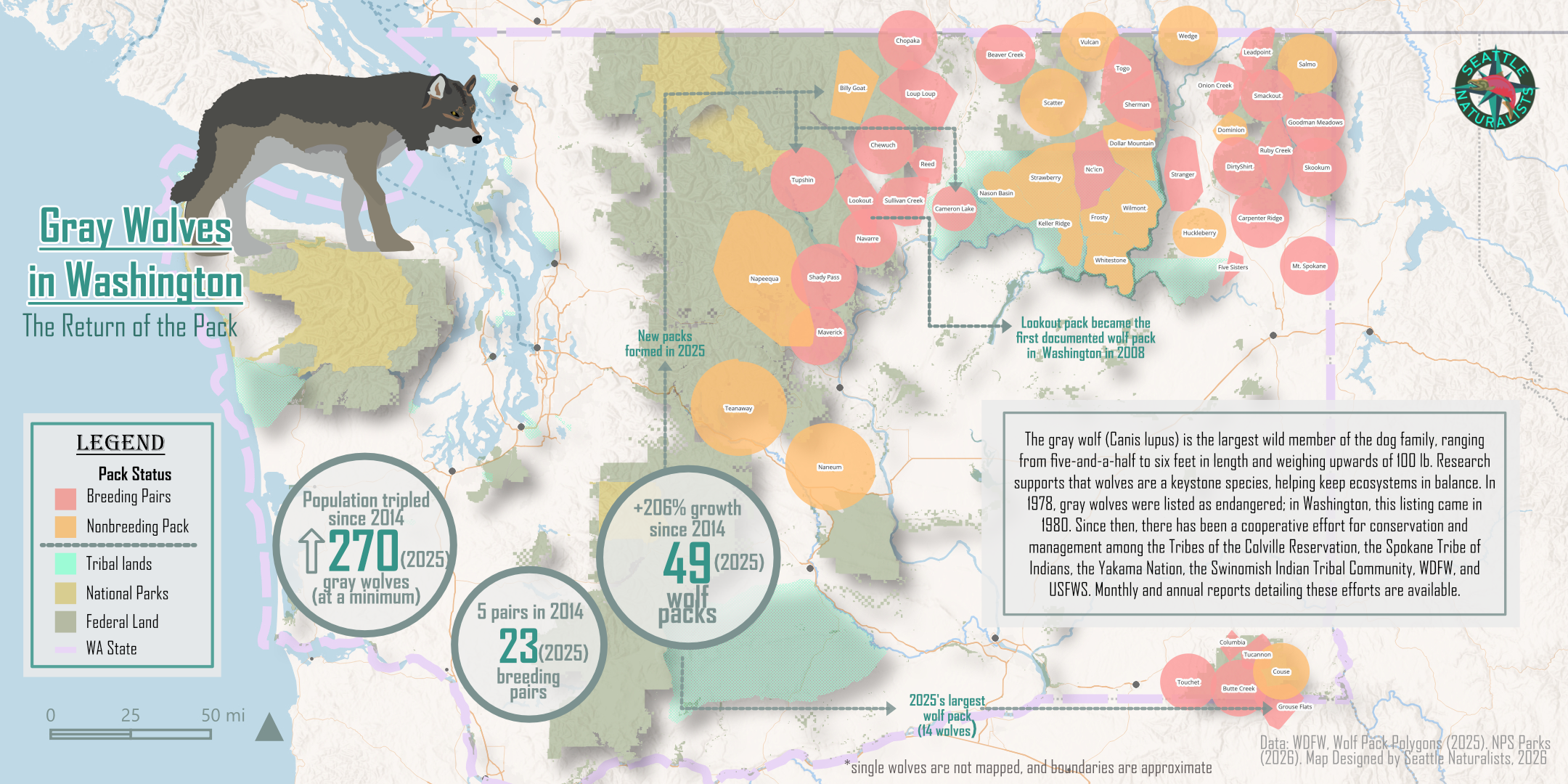
Gray wolves are continuing to strength their numbers, especially in Eastern Washington and the Northern Cascades. While there are no breeding pairs in the Southern Cascades and Northwest Coast, there’s real potential for the population to expand.
Map Overview: Here’s where things stand from 2014 to 2025.
The Washington wolf population has increased to at least 270 wolves, more than triple what is was in 2014. Breeding pairs rose from 5 to 23 pairs over that period, and the number of known packs increased from 16 to 49 in 2025.
I particularly find the additions of the new packs exciting. Especially the ones on the outskirts like Billy Goat (non-breeding) and Tupshin (breeding) packs because they represent wolves expanding into new territories and establishing an expanded range. With wolf packs absent in the Southern Cascades and Northwest Coast, they represent hope for re-establishing their range to be statewide. Looking at the data from previous years, 2022 and 2023 are notable in closing a range gap between Colville Rez and Cle Elum. If anyone wants to speak to that, by all means- I’m interested.
A little background on the species. The gray world, Canis lupus, is the largest wild member of the dog family, typically five-and-a-half to six feet in length and weighing upwards of 100 pounds. Research supports that wolves are a keystone species, meaning they play an outsize role in keeping ecosystems balanced.
Gray wolves were listed as endangered in 1978, and in Washington that listing came in 1980. Since then , recovery has relied on an ongoing cooperative effort between Confederated Tribes of Colville Reservation, the Spokane Tribe of Indians, the Yakima Nation, the Swinomish Indian Tribal Community, WDFW, and USFWS.
Disclaimer: the numbers shared here are minimum known counts, not full population estimates due to single wolves being hard to count. Data is as recent as of December 2025. For the most current and complete reporting, go directly to WDFW’s wolf conservation page or Tribes directly. This map is for cartographic purposes only and should only be referenced as art.
Sources:
Washington Department of Fish & Wildlife. (n.d.). Gray wolf conservation and management. WDFW. https://wdfw.wa.gov/species-habitats/at-risk/species-recovery/gray-wolf
Washington Department of Fish and Wildlife. (n.d.). Wolf [Data set search]. WDFW Open Data. Retrieved July 27, 2026, from https://data-wdfw.opendata.arcgis.com/search?q=wolf